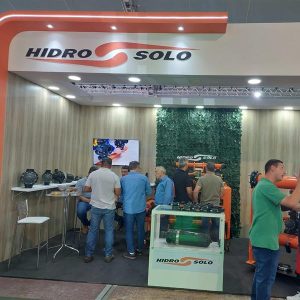
Hidro Solo at Fenicafé 2026: irrigation technology to boost Brazilian coffee farming
01 de abril de 2026Hidro Solo confirms its participation in Fenicafé 2026, one of Brazil’s main trade f [...]
12 fev 2020
By: Hidrol Team
Posted on: Water treatment
Case Study
Some considerations:
Filtration Efficiency:
a. It is known that filtration in a sand filter is more efficient due to the depth of the bed. That is, the longer the path the water travels through the filter bed, the better. In water treatment plants, this bed varies from 50 cm to 150 cm in depth. In vertical sand filters for irrigation, 35 to 40 cm is used to reduce costs.
b. Regarding backwashing to clean the filter bed, it is known that for good efficiency in this process, and consequently the restoration of operating conditions, an expansion of 20 to 40% of the sand is required. Smaller expansion allows impurities to remain trapped in the sand, and this bed will clog until it completely loses efficiency.
c. Regarding the internal flow direction during backwashing, there must be space not only for the expansion of the bed but also for its rearrangement after backwashing, ensuring the filter bed is evenly distributed over the strainers, avoiding localized dunes and exposed areas that uncover the strainers.
Anti-Corrosion Treatment:
It is essential that the interior of the filter is accessible to receive proper anti-corrosion treatment. Its lifespan depends on this.
How we do it:
Hidro Solo’s standard anti-corrosion treatment consists of high-tech pickling, phosphating, internal and external epoxy powder coating, and final external coating with polyester resin, cured in an oven at 230°C. This last layer is UV resistant, allowing the filter to be installed without a cover. As additional protection, liquid epoxy resin is applied to the internal weld joints.
Concrete case analysis:
A horizontal filter with a 400 mm diameter was analyzed.
In this filter, we have:
False bottom height: 120 mm;
Strainer height: 90 mm;
Energy dissipator 60 mm from the top;
Space for filter bed and its expansion (between the top of the strainer and the energy dissipator): 130 mm. This height is totally insufficient for setting up the filter bed and providing for its expansion;
Sand volume to cover the strainers: 46 liters;
Sand volume recommended by the manufacturer: 38 liters (60 kg). That is, the recommended amount of sand is not enough to cover the strainers;
Absolute lack of any anti-corrosion protection inside the filter.
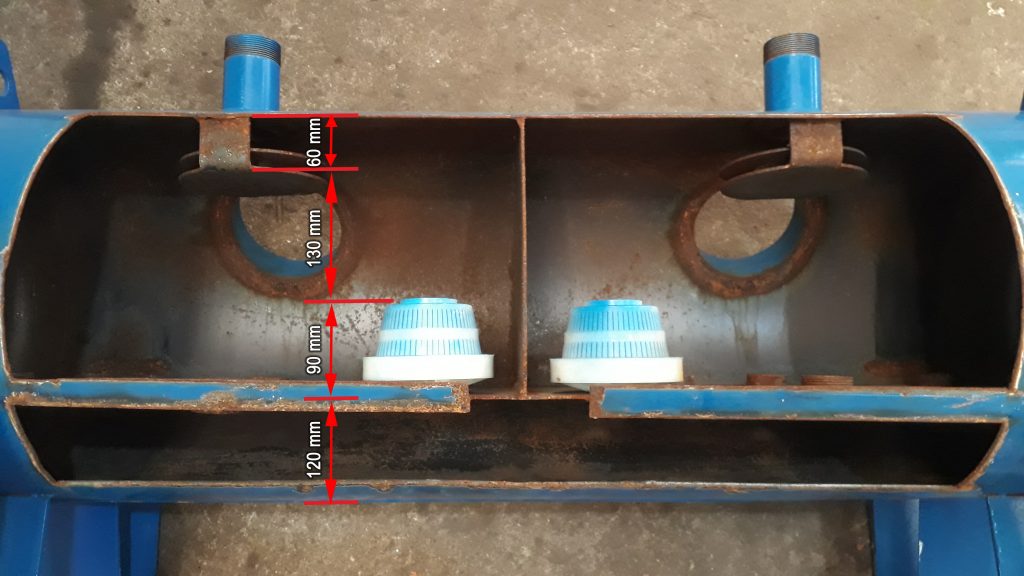
Photo 1: Filter subject of this study.
All things considered, we have:
The recommended sand volume does not cover the strainers, which are performing the filtering function, which should actually be done by the sand.
If we fill the sand up to 50% of the available space for the filter bed, we will have a filter bed of only 6 cm above the strainers and only 6 cm of expansion space from the filter bed, which will certainly be expelled during backwashing.
With 6 strainers in each chamber, such little space for expansion, and an extremely shallow filter bed, there is a tendency, due to the fluid’s hydrodynamic behavior, to form small dunes under the backwash discharge nipples, further exposing the strainers at the ends.
The lack of internal anti-corrosion treatment completely compromises the filter’s lifespan, which will be very short depending on the water quality.
How we do it:
Hidro Solo sand filters have a minimum filter bed height of 35 cm, providing greater filtration depth and consequently better final water quality for the drip lines. There is also an additional 25 cm of height available for sand expansion during backwashing, allowing the backwash flow rate to be sized properly to expand the bed adequately, avoiding clogging without the risk of losing the filter material.
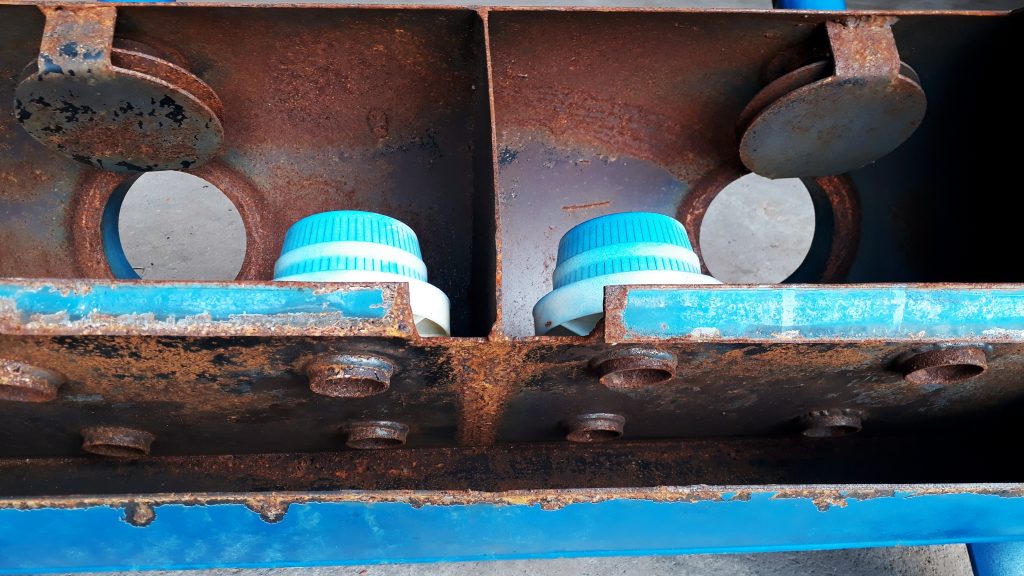
Photo 2: Details of the lack of internal anti-corrosion treatment.
We can conclude that this horizontal filter is inefficient as such, with the only advantage being a low price.
As manufacturers of sand filters, we have studied the technical feasibility of this type of configuration for over 20 years and concluded that, for the reasons detailed above, it is a technically unsustainable option that only meets the price criterion, completely disregarding quality and disrespecting customers.
Hidro Solo, respecting the market, values the quality and longevity of its products. Therefore, this type of horizontal sand filter configuration will not be part of our manufacturing scope.
How we do it:
All Hidro Solo filters are made of A36 carbon steel, with ASME 10% torispherical heads at the ends welded to the cylindrical body with total fusion of the joint area, ensuring local strength superior to the material being welded. The filters are sized according to ASME Section VIII, Division 1.
To optimize performance, we developed and patented our own high-performance strainer, which, combined with excellent spatial distribution, allows us to have one of the filters with the lowest pressure loss on the market.

Hidro Solo confirms its participation in Fenicafé 2026, one of Brazil’s main trade f [...]
A new federal decree may expand sustainable solutions in sanitation, enabling the co [...]
In Rio das Ostras (RJ), this movement has gained national prominence: the municipali [...]