Hidro Solo at Fenicafé 2026: irrigation technology to boost Brazilian coffee farming
01 de abril de 2026Hidro Solo confirms its participation in Fenicafé 2026, one of Brazil’s main trade f [...]
10 fev 2026
By: Hidrol Team
Posted on: Water treatment

One of the greatest environmental and social challenges Brazil faces today is related to water security. According to the study Future Water Demand in 2050: Challenges of Efficiency and Climate Change, prepared by the Trata Brasil Institute in partnership with the consultancy Ex Ante, alarming projections indicate significant risks of water supply restrictions by 2050 if strategic actions are not implemented in the coming years.
This study, widely reported by outlets such as Saneamento Hoje, indicates that, on average, Brazil may face up to 12 days of water rationing per year by 2050, with some drier regions reaching much higher levels, especially in the Northeast and Midwest, where water scarcity is already a reality.
Some of the main points highlighted in the survey show that:
● The country’s average temperature is expected to rise by 2050, reducing the number of rainy days and altering precipitation patterns, which may compromise water availability.
● Water demand is expected to increase by up to 59.3%, driven by population growth, urban and economic expansion, as well as consumption habits influenced by rising temperatures.
● Without loss reduction and with the inefficiency of current systems, Brazil may face significant restrictions, affecting everything from urban supply to essential activities in industry and agriculture.
These projections highlight that Brazil needs to restructure its water management and invest in structural solutions, including loss reduction, modernization of water and sewage systems, and the adoption of robust treatment technologies.
In a scenario of increasing pressure on water resources, the efficiency of the water treatment process becomes even more essential. Equipment that ensures higher performance, less waste, and greater operational reliability are key pillars to face the challenges projected by the Trata Brasil study.
This is where Hidro Solo’s role becomes strategic.
Hidro Solo, a national reference in the manufacturing of solutions for water treatment and irrigation, develops technologies that help increase the efficiency of hydraulic systems in Water Treatment Plants (WTPs) and other critical sanitation points.
Among the solutions that directly contribute to improving the use of treated water are:
● Pluvitec Strainers: components that ensure uniform water distribution in the filter bed, higher filtration efficiency, and effective backwashing with minimal head loss.
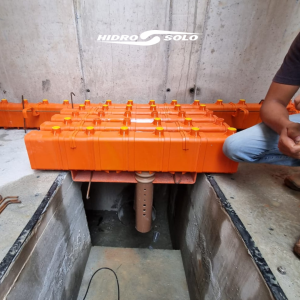
● Confined Flow Bottoms: filtration technology that improves particle removal capacity and reduces the need for frequent maintenance.
These technologies not only improve water treatment quality but also reduce operational costs and losses—central factors when considering the projections for water demand through 2050.
The warning issued by the Trata Brasil Institute shows that ensuring quality water in sufficient quantity for the entire Brazilian population depends on initiatives focused on efficiency, innovation, and intelligent resource management. In this context, Hidro Solo strengthens its commitment to solutions that not only improve processes in WTPs, but also contribute to a more resilient Brazil in the face of climate and consumption challenges.
If you want to learn more about how Hidro Solo technologies can strengthen your water treatment project, visit: https://hidrosolo.com.br/pt.
Texto escrito com informações de: Saneamento Hoje

Hidro Solo confirms its participation in Fenicafé 2026, one of Brazil’s main trade f [...]
A new federal decree may expand sustainable solutions in sanitation, enabling the co [...]
In Rio das Ostras (RJ), this movement has gained national prominence: the municipali [...]